
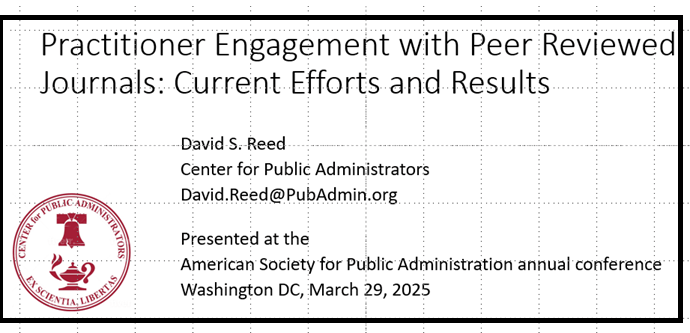
Peer reviewed journals are making some efforts to increase the involvement of practitioners, adjunct faculty, and students. I described the strategies they are using in my presentation at the American Society for Public Administration conference on March 29. The slides are here: https://publishpeerreview.org/wp-content/uploads/2025/03/practitioners-in-peer-reviewed-journals-for-aspa-conference-2025.pdf
Month: March 2025
How to Read Journal Articles for Free
To publish a peer reviewed article, you have to read peer reviewed articles. University libraries have group subscriptinos with the major journal publishers that let their faculty and students download articles for free. If you don’t have a university library card, then the journal publisher may charge fifty dollars to read and download each article from its website.There are ways around this cost, which I describe in this working paper: https://publishpeerreview.org/wp-content/uploads/2025/03/how-to-read-journal-articles-for-free.pdf
Why should practitioners publish in peer reviewed journals?
If you have some knowledge to share, then why publish it in a peer reviewed journal rather than the quicker and easier route of just posting it to a blog? Dr. Annette N. Brown answered this in her excellent article, “Why should practitioners publish their research in journals?”
Brown’s article became a real life example of one advantage of journals. She published it as a blog post in 2017, and it is no longer available on the blog or anyplace else I can find on the internet. This is despite the fact that it is a valuable article and has even been cited in peer reviewed literature. By contrast, articles in journals are preserved permanently in the redundant collections of publishers, libraries and archives. As Brown wrote, “If the question is salient enough to do research, and the research findings are credible enough to disseminate publicly, then shouldn’t we make sure they enter the permanent, searchable, public record?” Since Brown’s article isn’t in that permanent public record, you can read my personal marked-up copy here: https://publishpeerreview.org/wp-content/uploads/2025/03/2017_why-should-practitioners-publish-their-research-in-journals.pdf
Brown pointed out two other advantages of publishing in peer reviewed journals. First, it increases the credibility of the research. As she wrote, “Submission to a peer-reviewed journal is an important signal, both that the researcher feels the work is of a standard to be published in a journal and that she is willing to undergo rigorous external peer review.”
Second, publishing in a peer reviewed journal increases the credibility of the practitioner. Brown cited her own experience, “Over my career I have recruited for hundreds of short-term and long-term positions for USAID and other funder proposals and projects, and while a record of journal publication is rarely a necessary credential, it is often a favored credential.”
Helping you get published, like I did, but faster
This website is an ongoing project to help people get published in peer reviewed journals, even if they are not being mentored in the “hidden curriculum” of how journals work. I’m David Reed. I’m a practitioner, rather than a professor, so I was not being mentored in the hidden curriculum. I learned by searching out information, building relationships, and lots of trial and error. Eventually I succeeded in becoming an author, peer reviewer, and Associate Editor for peer reviewed journals. This website, and the book that I plan to develop from it, will present what I wish I had known early on, to give you a head start.
I will be posting new how-to articles to this website as they develop, probably about two a month. You can enter your email address here to receive each new post:
 How to Get Published in Peer Reviewed Journals